
When did you first start paying attention to your height?
Maybe it was a photo. You stood next to someone else and suddenly looked shorter than you expected. Maybe you measured yourself after a long time and the mark on the wall had barely moved. Or maybe someone around you grew noticeably during one school break while you seemed to stay the same.
That is when the questions usually begin.
Can I still grow taller? How can I grow faster? Why do some girls seem to grow earlier than boys? Is there still a chance after 18? Does milk help? What about calcium pills, vitamins, protein powder, or height-growth tablets?
These questions all lead back to one point:
To know whether more height growth is possible, you first need to know whether the body is still in a growth period.
If the body is still growing, sleep, nutrition, physical activity, illness, puberty timing, and overall health can all affect whether growth continues normally. These factors cannot make someone ignore genetics, but they can influence whether the body has the conditions it needs to reach its natural growth potential.
If the growth period has ended, the situation changes. Stretching, hanging exercises, jumping, swimming, basketball, supplements, and over-the-counter height products cannot make mature long bones start growing again.
So the first question should not be, “Which exercise or food makes me taller?”
It should be:
Does my body still have the conditions for more height growth?

Why Do Humans Grow Taller?
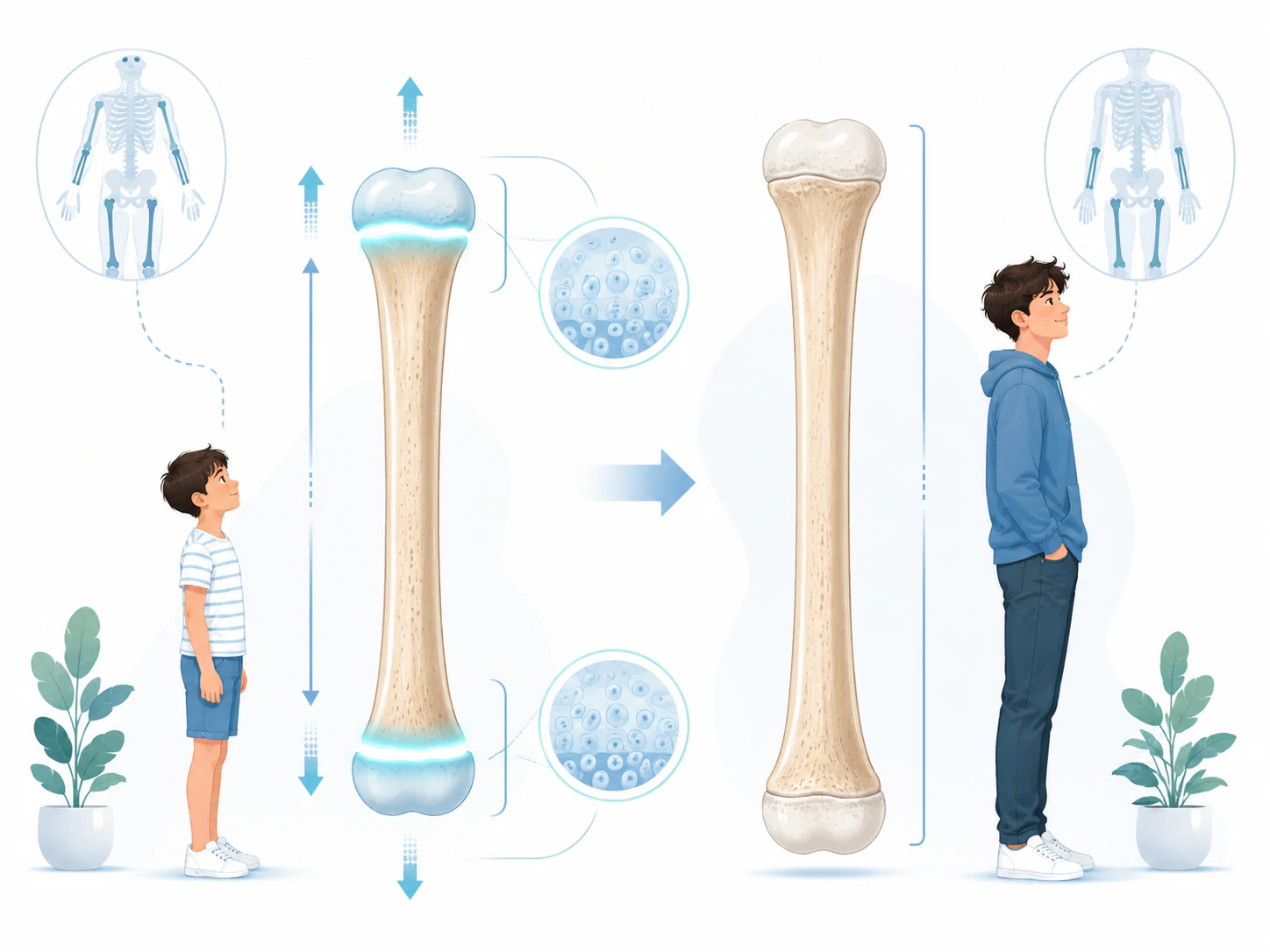
Humans grow taller mainly because bones lengthen during development.
In children and teenagers, the ends of long bones contain areas of developing cartilage called growth plates. These areas are where new bone tissue forms while the body is still growing. As the long bones slowly lengthen, height increases.
Near the end of puberty, growth plates gradually close. The soft growth areas are replaced by mature bone tissue. Once that happens, long-bone length is mostly set.
That is why children and teenagers can naturally grow taller, while most adults cannot increase their true skeletal height.
Stretching can improve flexibility. Exercise can strengthen muscles, bones, and the heart. Posture training can help someone stand more upright.
But none of these are the same as making mature bones longer.
Many height myths come from mixing up four different ideas: looking taller, standing straighter, becoming healthier, and continuing skeletal growth.
If someone is still in a growth period, the goal is to support normal development. If the growth period has already ended, the focus should shift to posture, body proportion, strength, and health instead of chasing fast-height methods.
Do Not Judge Growth Potential by Age Alone
People often ask:
Can I still grow at 15? Can I grow after 18? Do girls stop growing soon after their first period? Can boys keep growing into their twenties?
Age gives only a rough clue.
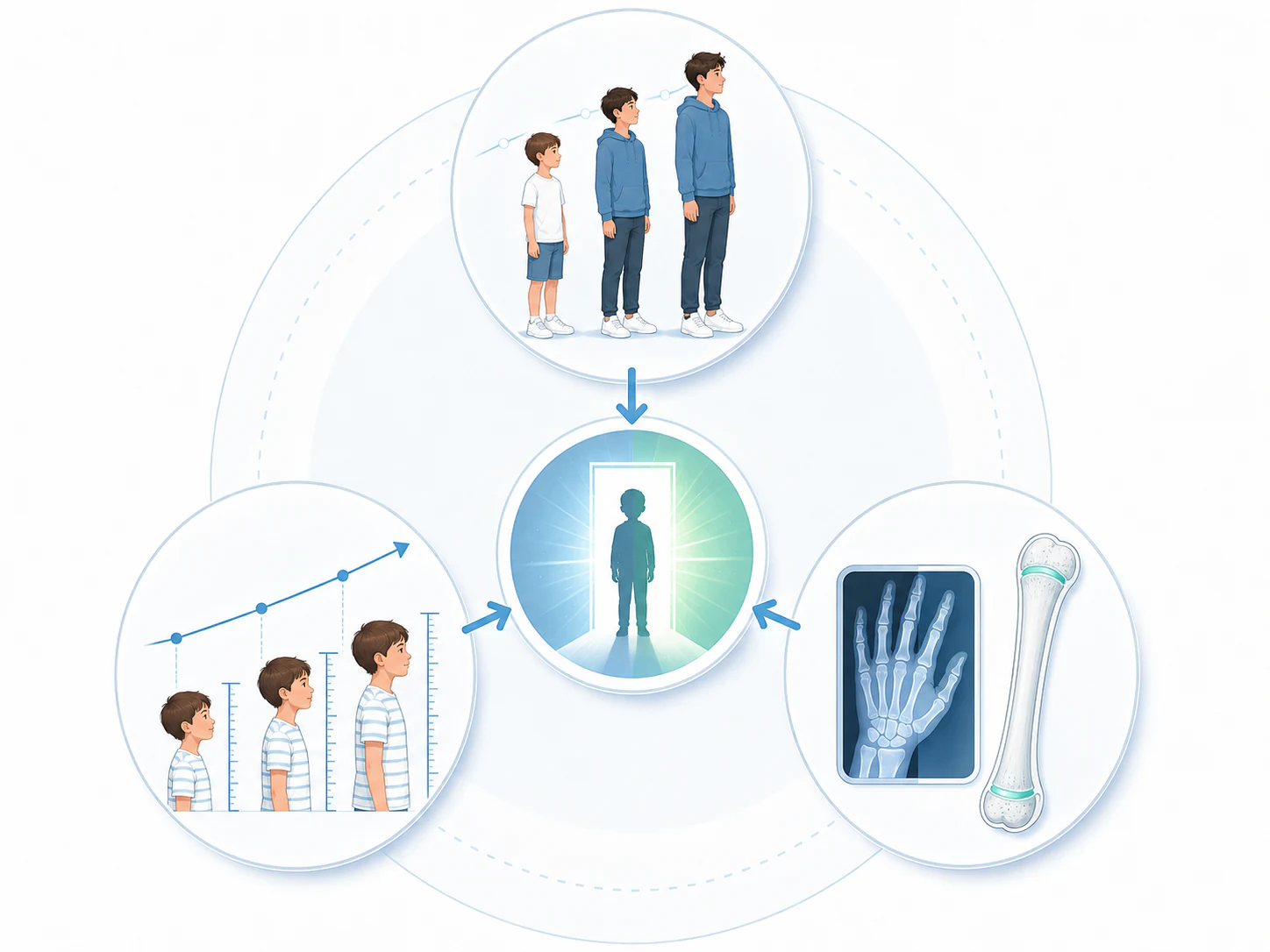
A better way to think about height growth is the growth window. This window is not decided by birthday alone. It depends on three things.
First, puberty stage. Some people mature early and are already close to adult height by their mid-teens. Others mature later and may not yet have reached their main growth spurt at the same age.
Second, recent height change. One height number does not say much. A better question is whether height has continued to change over the past six to twelve months. Someone who has barely changed for a long time is not in the same situation as someone who is still gaining height steadily.
Third, skeletal maturity. If growth plates are still open, natural height growth may still be possible. If growth plates have closed, ordinary exercise, stretching, diet changes, or supplements cannot lengthen long bones.
The better question is not simply, “Am I old enough to stop growing?”
It is:
Am I still inside my own growth window?
How Do Doctors Estimate Remaining Growth Potential?
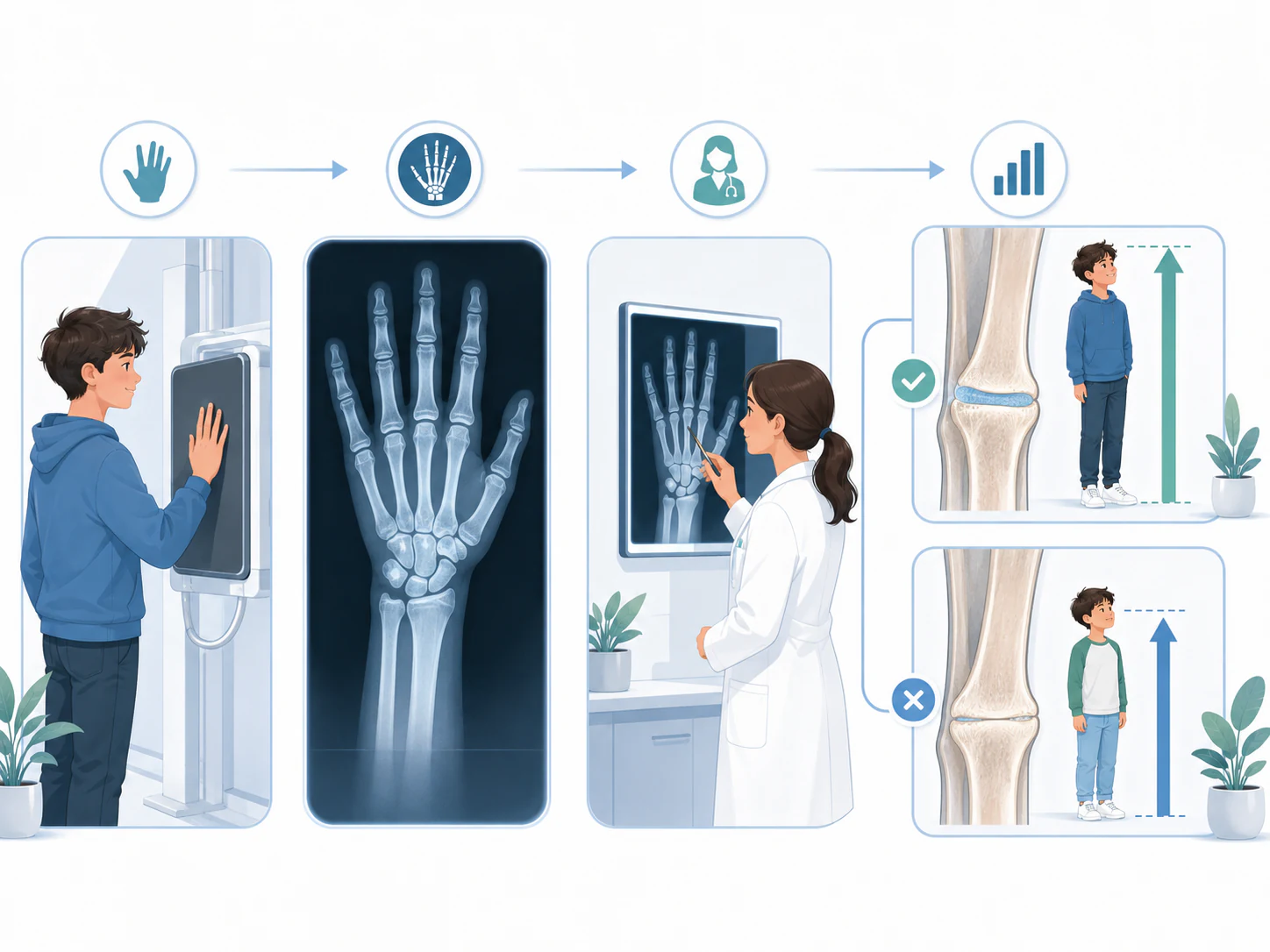
Doctors may use a test called a bone age X-ray to help estimate skeletal maturity in children and teenagers.
This exam usually uses an X-ray of the left hand, wrist, and fingers. A doctor compares bone development on the image with standard references to estimate bone age.
Bone age is not always the same as chronological age.
A child who is 13 years old may have a bone age closer to 12, or closer to 15. The first case suggests relatively later skeletal maturity. The second suggests earlier skeletal maturity. Two people can be the same age but have very different remaining growth potential.
Someone may look short but have delayed bone age and more time to grow. Someone may already be average or tall, but have advanced bone age and less remaining growth. Someone may gain a small amount after 18 because development was late. Someone else may stop changing around 16 or 17 because skeletal maturity is already close to complete.
A better assessment looks at three things together:
Actual age. This gives a general population context. A height percentile calculator can show where a child or teen sits against age and sex references, but it does not decide the outcome by itself.
Height change over time. If height is still increasing over six to twelve months, the body may still be changing. If height has barely changed for a long time, puberty stage and skeletal maturity become more important. A height predictor can add family-height context, but it should be read alongside real growth records.
Bone age and growth plate status. If bones are not fully mature, some natural growth potential may remain. If growth plates are close to closed or already closed, ordinary exercise, diet, stretching, or supplements cannot make long bones keep lengthening.
Bone age testing is a medical exam. Whether it is needed should be decided by a doctor based on growth rate, puberty stage, family height, and health history.
Chronological age is the surface. Bone age is closer to the body’s own clock.
Same Age Does Not Mean Same Development Stage
Height anxiety often becomes strongest during puberty because comparison is easy and unfair.
In the same class, one student may already have a deeper voice, broader shoulders, and rapid height gain. Another may look as if puberty has barely started. Girls may temporarily become taller than many boys in early adolescence. Some boys may catch up later.
This is not a race. Often, it is just different timing.
People of the same age may be in very different situations:
- already past the fastest growth phase;
- currently in a growth spurt;
- not yet clearly started;
- consistently shorter but growing at a normal pace;
- not short right now, but already close to stopping.
A common mistake during puberty is treating “same age” as “same stage.”
A 13-year-old boy who is shorter than some girls in his class is not automatically headed toward a short adult height. The girls may simply have entered their growth spurt earlier. A 14-year-old girl whose growth has slowed is not automatically abnormal. She may have already passed her fastest growth phase. A 15-year-old boy who has not grown much yet cannot be judged from one comparison. Puberty signs, growth records, and family development patterns matter.
Height comparison only shows the result at one moment. Development depends on the timing behind that result.
Puberty Is the Last Major Height-Growth Phase for Most People
Human height does not increase at the same speed every day.
A child may look unchanged for several months and then grow noticeably. A teenager may outgrow trousers during one summer and then enter a slower period. A late developer may look behind at first and catch up later.
From childhood through puberty, height generally has two important phases.
Childhood: steady growth
Childhood growth is usually steadier than puberty growth. This phase may not look dramatic, but it matters.
Long-term undernutrition, chronic illness, severe sleep problems, or endocrine issues may gradually show up in the growth pattern. It is often not obvious in a day or a week. It may appear over months or years as the growth curve starts to move away from the child’s previous pattern.
For children, the question is not only “How tall today?” It is whether growth is continuing over time.
Puberty: the final major acceleration
Puberty is the last major phase of rapid height growth for most people.
This stage is influenced by sex hormones, growth hormone, thyroid function, nutrition, sleep, physical activity, and overall health. The sudden “shooting up” many people remember usually happens during puberty.
Puberty does not begin at the same time for everyone.
Early developers may look taller at first. Late developers may look shorter early on but still have more growth remaining.
Height differences among people of the same age do not necessarily predict adult height.
A 13- or 14-year-old who is currently shorter may simply be developing later. A person who has already passed the peak puberty growth phase will naturally slow down. What deserves attention is height that barely changes for a long time, a clear drop in growth rate, or puberty that has not started when expected.
Boys and Girls Follow Different Growth Timelines
Much height anxiety comes from comparison.
A boy may wonder why girls in his class are taller. A girl or parent may worry that height growth is nearly over after the first period. Parents may worry that a shorter child will always stay short.
These questions cannot be answered by age alone.
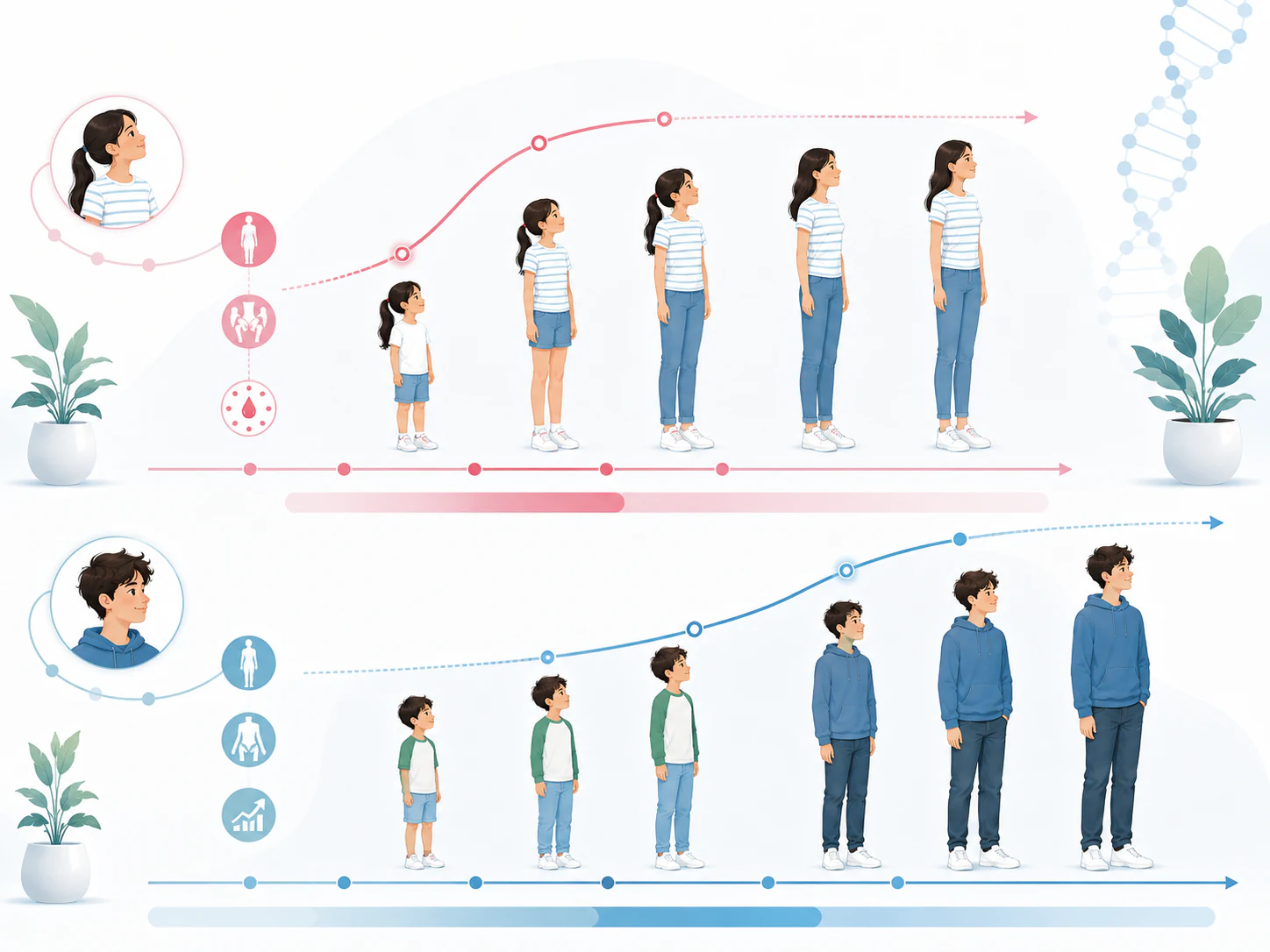
Boys and girls usually enter puberty at different times and reach their fastest height growth at different times.
Girls usually grow earlier and slow earlier
Girls generally enter puberty earlier than boys. Their noticeable height growth also tends to happen earlier.
In early adolescence, girls may temporarily be taller than boys of the same age. That often happens because girls enter the fast-growth phase earlier.
The first menstrual period usually means that a girl has entered the later part of puberty. Height gain often slows after this point, but it does not stop on that exact day. Many girls continue to grow for a while after menarche, just at a slower pace.
A more accurate statement is:
After the first period, girls may still grow, but the fastest part of height growth is usually already past.
Boys usually grow later and may continue longer
Boys generally enter puberty later than girls, and their fastest height growth usually comes later.
This means some boys may look shorter than girls or some classmates in early adolescence without anything being wrong. Many boys have their strongest growth later.
Boys often continue growing for longer, which is one reason adult men are taller than adult women on average.
But boys do not have unlimited time. Puberty ends, and growth plates eventually close. Boys and girls have different timing, but neither group grows indefinitely.
If a boy shows no signs of puberty by the expected age, or puberty starts and then does not progress, medical evaluation is more useful than waiting and guessing.
If You Want to Grow Taller, First Stop Holding the Body Back
When people think about increasing height, they often look for something immediate.
How many jumps per day? How long should I hang from a bar? What food should I eat? What time should I sleep? Which routine should I follow? How much milk should I drink? Which calcium tablet should I take? Is there a height pill?
These questions are understandable, but they can make height sound like something controlled by one action.
For someone who is still developing, a better starting point is:
Do not make the growth environment worse during the years when growth is still possible.
Chronic sleep loss, low energy intake, poor diet quality, extreme dieting, overtraining, and untreated health problems can all put the body in a less favorable state for normal development.
The body is not a machine where one input produces a fixed number of extra centimeters. It is a growing system. Materials, rest, hormones, and health status all have to support the process.
Four Growth Conditions You Should Not Undermine
1. Sleep debt
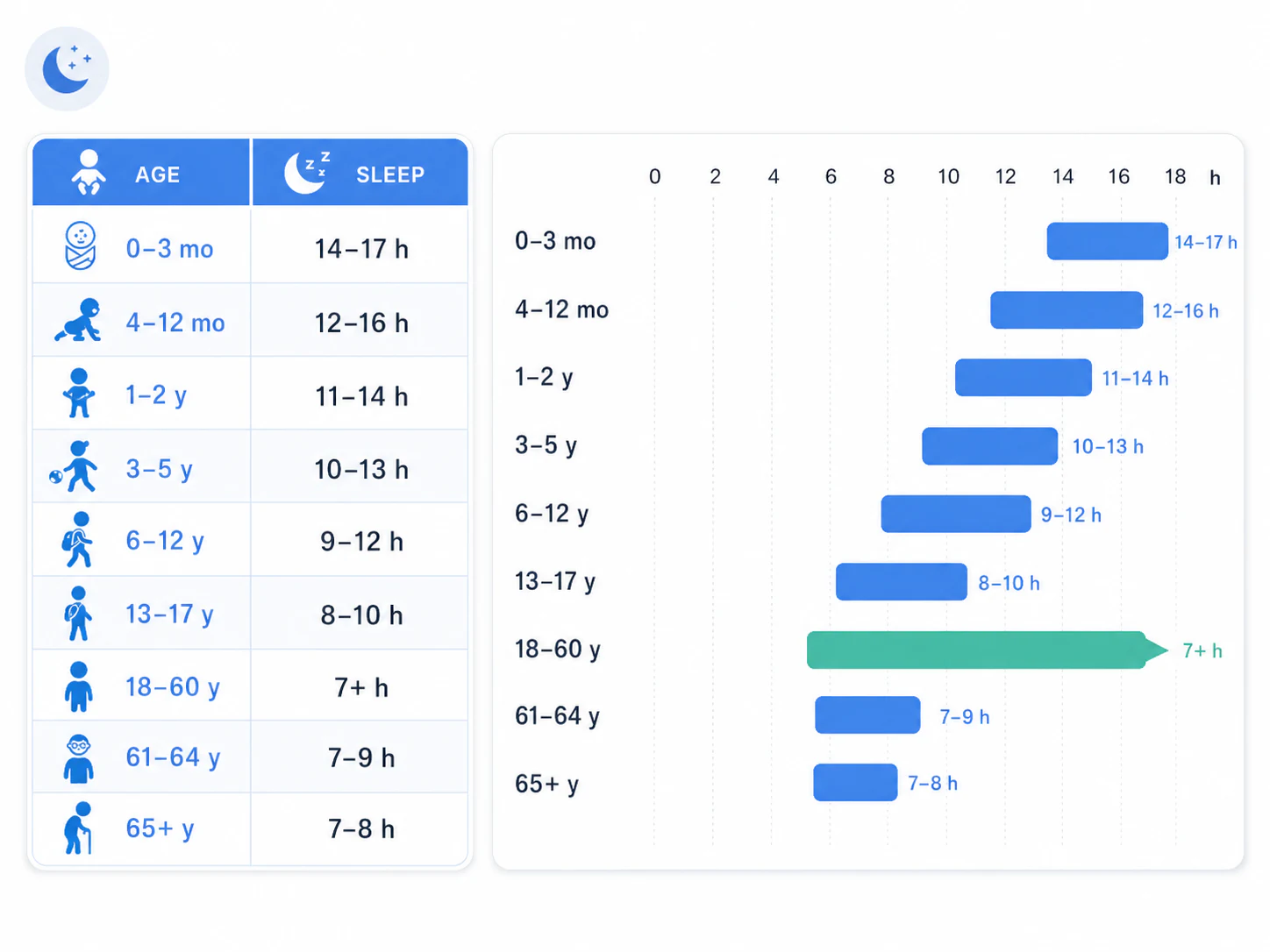
One late night will not decide someone’s height. Chronic sleep debt is different.
For example, staying up until very late for months, relying on caffeine or sweet drinks during the day, and trying to recover only on weekends is not a friendly rhythm for a growing body.
Sleep is not a height button, but it is part of the body’s recovery and development environment.
Recommended sleep ranges differ by age:
| Age | Recommended sleep per day |
|---|---|
| 0–3 months | 14–17 hours |
| 4–12 months | 12–16 hours, including naps |
| 1–2 years | 11–14 hours, including naps |
| 3–5 years | 10–13 hours, including naps |
| 6–12 years | 9–12 hours |
| 13–17 years | 8–10 hours |
| 18–60 years | 7 or more hours |
| 61–64 years | 7–9 hours |
| 65+ years | 7–8 hours |
Practical habits:
- keep bedtime and wake time as consistent as possible;
- avoid staying up very late for long periods;
- reduce phone use and intense stimulation before bed;
- do not rely on weekend sleep to repair chronic sleep loss;
- talk to a clinician if insomnia, loud snoring, or extreme daytime sleepiness persists.
2. Not eating enough or not eating well enough
Growing taller does not only require calcium.
Bones, muscles, blood, hormones, and recovery systems all take part in development. The body needs enough total energy, protein, calcium, vitamin D, phosphorus, magnesium, zinc, iron, and overall diet quality.
The question is not “Which one food makes me taller?”
Better questions are:
- Am I eating too little for long periods?
- Am I skipping meals regularly?
- Am I cutting carbohydrates and protein too aggressively to control weight?
- Am I training a lot but not eating enough?
- Am I replacing meals with snacks and sugary drinks?
- Is my diet extremely limited or repetitive?
If the body does not reliably get enough basic materials, “growing faster” has no foundation.
The practical target is simple:
Eat enough, eat consistently, and eat a varied diet.
Which Nutrients Actually Matter?
Many people first think about concrete items:
Does protein help? Does milk make you taller? Should children take calcium tablets? Do vitamins help? Can height pills or gummies work?
If the body is still growing, nutrition matters. But no single food, nutrient, or supplement decides height by itself.
Height growth depends on a whole set of conditions working together.
Protein: building material, not a height accelerator
Protein is important for growth and development.
The body needs protein to build cells, repair tissues, and develop muscles and organs. A growing person who eats too little or lacks reliable protein sources may not be in an ideal developmental state.
That does not mean more protein automatically means more height.
General daily protein reference amounts for healthy people include:
| Age / group | Daily protein reference amount |
|---|---|
| 1–3 years | 13 g |
| 4–8 years | 19 g |
| 9–13 years | 34 g |
| Girls 14–18 years | 46 g |
| Boys 14–18 years | 52 g |
| Adult women | 46 g |
| Adult men | 56 g |
Children with heavy training, illness recovery, restrictive diets, vegetarian or vegan diets, or very low body weight may need individualized guidance from a clinician or registered dietitian.
Good protein sources include:
- eggs;
- fish, shrimp, and shellfish;
- poultry, lean beef, lean pork;
- milk, yogurt, and cheese;
- tofu, soy milk, beans, chickpeas, lentils;
- nuts and seeds.
A rough serving estimate: about 1 ounce / 30 g of meat, fish, or poultry; one large egg; 1/4 cup tofu; or 1/2 cup cooked beans or lentils often provides about 7 g of protein.
If a child already eats a varied diet, protein powder is usually not needed just for height. Protein powder is not “height powder.”
Pay closer attention if the child:
- skips breakfast often;
- cuts out staple foods, meat, eggs, or dairy to lose weight;
- trains a lot but eats little;
- is a very picky eater;
- follows a restrictive diet without planning protein sources.
Protein should be adequate, not excessive. Chasing protein can crowd out fruits, vegetables, whole grains, and other important foods.
Calcium: important for bones, but calcium pills are not height pills
Calcium is important for bones. Most of the body’s calcium is stored in bones and teeth, where it helps maintain structure and hardness. Calcium also plays roles in muscle, nerve, blood vessel, and hormone function.
Children and teenagers need enough calcium while bones are developing. Recommended intake is especially high from ages 9 to 18.
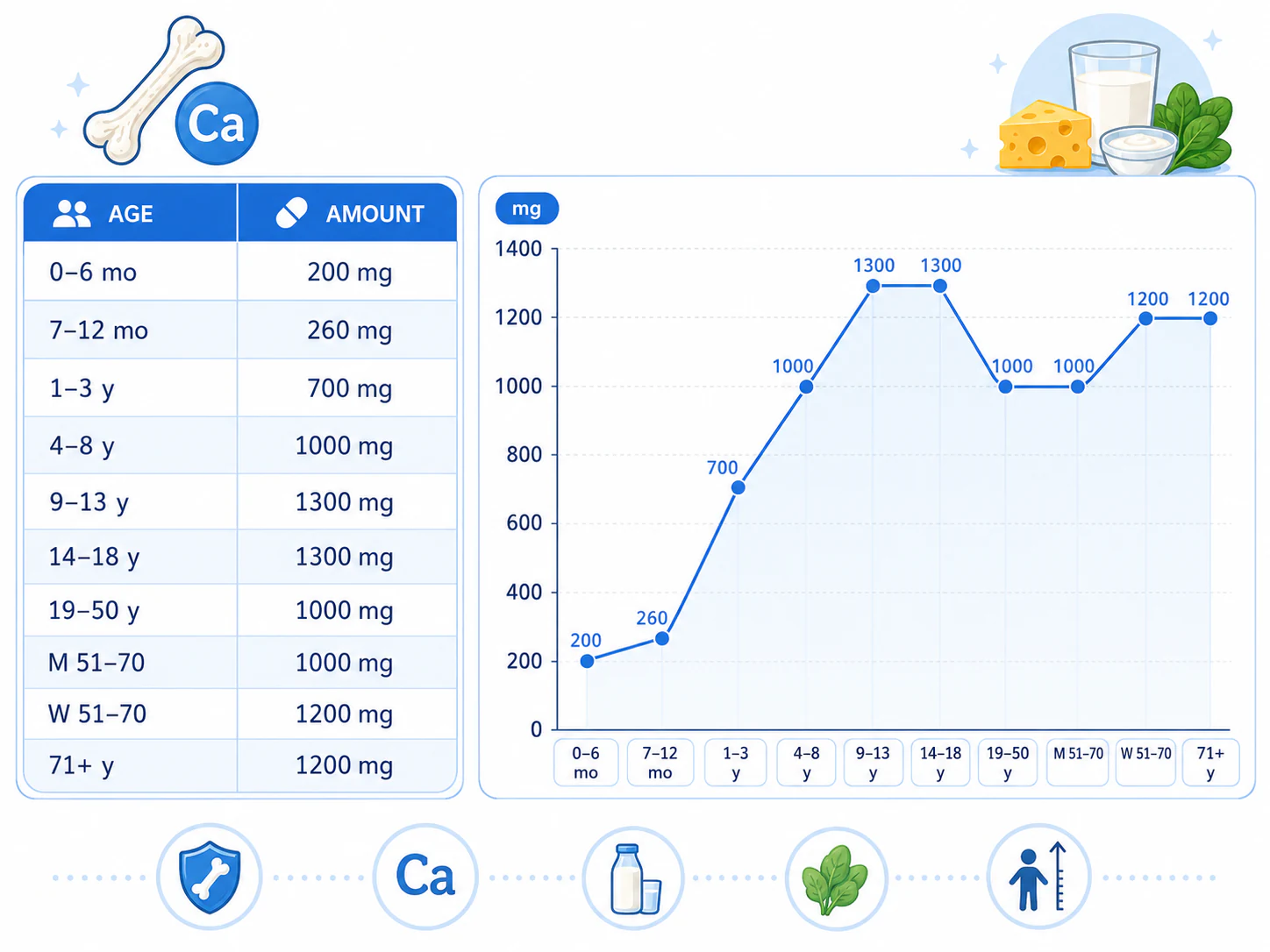
Daily calcium reference amounts:
| Age / group | Recommended calcium per day |
|---|---|
| 0–6 months | 200 mg |
| 7–12 months | 260 mg |
| 1–3 years | 700 mg |
| 4–8 years | 1000 mg |
| 9–13 years | 1300 mg |
| 14–18 years | 1300 mg |
| 19–50 years | 1000 mg |
| Men 51–70 years | 1000 mg |
| Women 51–70 years | 1200 mg |
| 71+ years | 1200 mg |
Good calcium sources include:
- milk;
- yogurt;
- cheese;
- calcium-fortified soy milk;
- tofu made with calcium salts;
- canned sardines or salmon with bones;
- kale, broccoli, bok choy, and other greens;
- calcium-fortified cereals or drinks.
Milk, yogurt, and cheese are common calcium sources. A cup of milk often provides around 300 mg of calcium, but the exact amount varies by product, so the nutrition label matters.
Calcium supplements fill a gap. They do not create extra height.
If the diet is low in calcium, a doctor or dietitian may recommend food changes or supplements. If intake is already enough, taking a lot more calcium will not make bones grow indefinitely. If growth plates are closed, calcium tablets cannot restart long-bone growth.
A better order is:
- review the diet;
- estimate whether intake is low;
- supplement only when needed, preferably with professional guidance.
Vitamin D: helps calcium absorption, but is not a standalone height switch
Vitamin D matters for bone health because it helps the body absorb calcium.
Long-term vitamin D deficiency can affect bone health. It should not be ignored in children and teenagers who are still developing.
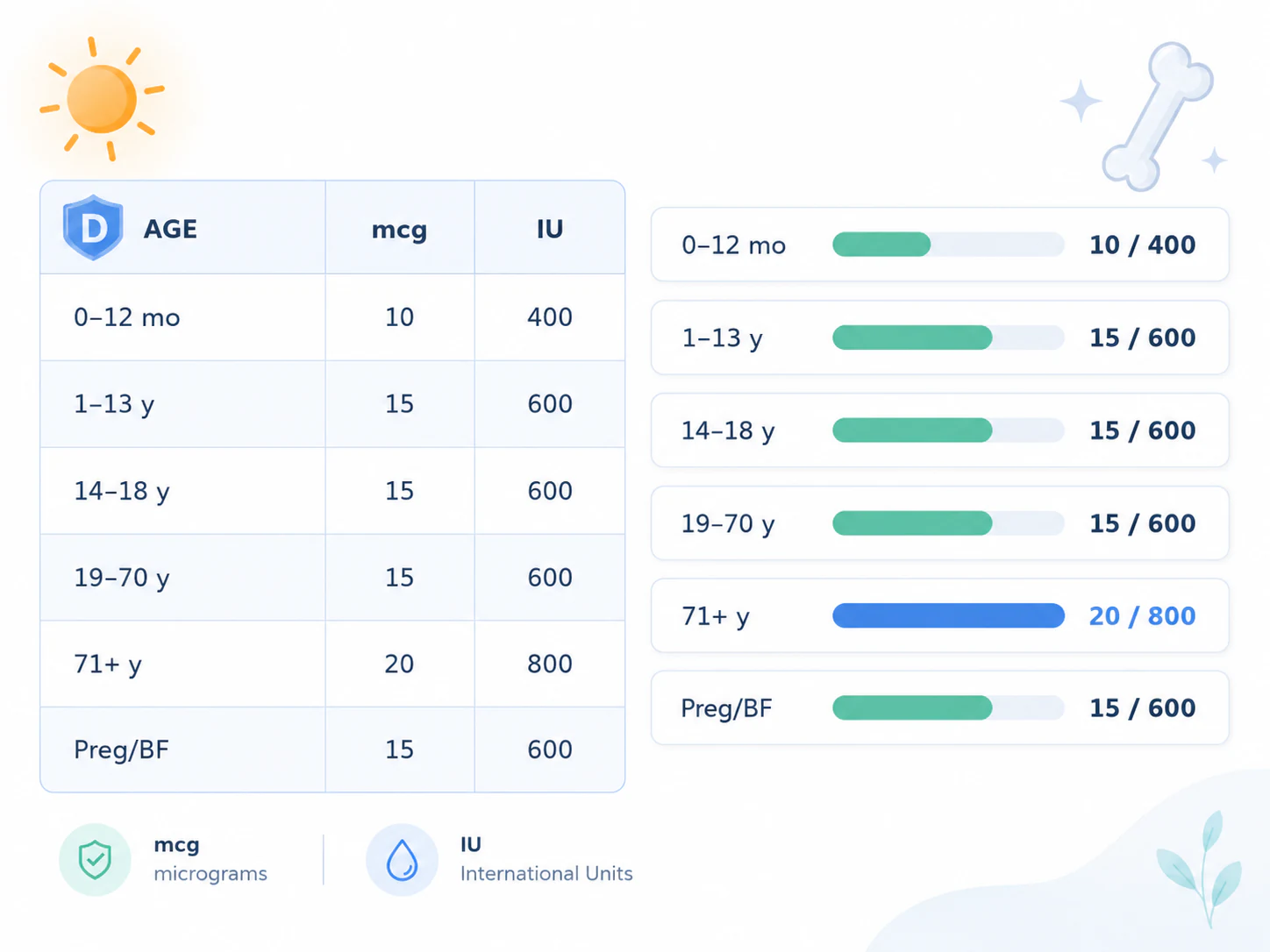
Daily vitamin D reference amounts:
| Age / group | Recommended vitamin D per day |
|---|---|
| 0–12 months | 10 mcg / 400 IU |
| 1–13 years | 15 mcg / 600 IU |
| 14–18 years | 15 mcg / 600 IU |
| 19–70 years | 15 mcg / 600 IU |
| 71+ years | 20 mcg / 800 IU |
| Pregnancy / breastfeeding | 15 mcg / 600 IU |
Vitamin D sources include:
- sun exposure in appropriate amounts;
- fortified milk;
- fortified soy milk;
- fortified yogurt;
- fortified breakfast cereals;
- fatty fish such as salmon, trout, tuna, and mackerel;
- egg yolks;
- mushrooms exposed to ultraviolet light.
Sunlight and vitamin D status depend on season, latitude, skin tone, sunscreen, time outdoors, clothing coverage, and air pollution. “Just get more sun” is not always enough or appropriate.
If vitamin D deficiency is suspected, a clinician can decide whether a blood test or supplement is needed. Taking high-dose vitamin D for a long time without guidance is not a height strategy.
Deficiency can be a problem; taking more does not mean growing taller.
Milk: useful for nutrition, not a height guarantee
Milk is often described as a “height food.”
Milk can provide protein and calcium. In some countries, milk is also fortified with vitamin D. For many children and teenagers, milk, yogurt, and cheese are convenient sources of bone-related nutrients.
But milk is not magic.
If a child’s diet is poor and low in protein or calcium, adding milk may help fill nutrition gaps. If the diet is already sufficient, drinking much more milk will not keep growth plates open for longer. If the growth period is over, milk cannot lengthen long bones.
People with lactose intolerance may have bloating, diarrhea, or stomach pain after drinking milk. They do not need to force it. Options can include yogurt, low-lactose milk, cheese, fortified soy milk, tofu, leafy greens, and small fish with bones.
Plant-based milks vary widely. Almond milk, oat milk, and rice milk may not match cow’s milk in protein, calcium, or vitamin D unless fortified. Fortified soy milk is often closer nutritionally, but labels still matter.
Milk can be part of a healthy diet. It is not a guarantee of height increase.
Multivitamins: useful for gaps, not a replacement for meals
Multivitamins are often treated as insurance.
If a child is very selective with food, eats a very narrow diet, or has a diagnosed nutrient gap, a multivitamin may help.
But it cannot replace normal meals and is not a height medicine.
A healthy diet should start with food:
- vegetables and fruits for vitamins, minerals, and fiber;
- whole grains for energy, fiber, and some vitamins;
- protein foods for tissue repair and development;
- dairy or fortified alternatives for calcium, protein, and some vitamins;
- water as the main everyday drink instead of sugary drinks.
Multivitamins are for filling gaps. They do not override genetics, puberty timing, or skeletal maturity.
Height pills and gummies: ask for evidence first
Many products are marketed as height tablets, height gummies, or growth supplements.
They often use claims such as:
- helps children exceed genetic limits;
- stimulates growth plates;
- promotes rapid bone growth;
- visible height gain in a few months;
- designed for children and teens.
The more certain the claim sounds, the more carefully it should be checked.
Ordinary nutrition supplements cannot reopen closed growth plates. They cannot replace medical evaluation. If a product suggests that it can guarantee height increase, ask:
- Is there reliable clinical evidence?
- Is the claim based only on selected testimonials?
- Is ordinary nutrition being presented as treatment?
- Is the product appropriate for the child’s age, bone age, and health status?
If these questions are not answered clearly, the product should not be treated as a height solution.
Growth hormone is not an online height drug
Medical growth hormone treatment is different from height pills or gummies sold online.
Growth hormone is a prescription treatment used for specific medical conditions, such as growth hormone deficiency. It requires medical evaluation, testing, diagnosis, dosing, and monitoring.
It also cannot bypass growth plate closure.
If growth plates are already closed, growth hormone cannot continue increasing height. The long bones no longer have open growth areas to lengthen.
If a child’s height growth appears clearly abnormal, the correct step is not to buy height products first. Track growth, review puberty signs, and see a pediatrician or pediatric endocrinologist.
Common Height Tips: What They Really Mean
| Common approach | Real role | Do not confuse it with |
|---|---|---|
| Eating more protein | Supports tissue, muscle, and development | More protein does not mean more height |
| Drinking milk | Provides protein and calcium; may help fill gaps | Milk does not guarantee height growth |
| Taking calcium tablets | May help if calcium intake is low | Not a height pill; cannot open growth plates |
| Taking vitamin D | Helps calcium absorption and bone health | Extra vitamin D does not mean extra height if not deficient |
| Taking a multivitamin | May fill diet gaps | Cannot replace meals |
| Taking height pills / gummies | Usually a supplement or marketing product | Cannot guarantee height gain |
| Using growth hormone | Prescription treatment for specific diagnoses | Not a casual height shortcut; ineffective after growth plates close |
Principle:
If growth is still possible, fill real gaps. If there is no gap, do not assume more is better. If the growth period is over, supplements are not a way to restart height growth.
3. Too little activity, or the wrong relationship with exercise
Exercise matters for development.
Running, jumping, climbing, swimming, sports, strength training, and bodyweight exercises can all help build a stronger body. Physical activity strengthens bones and muscles, supports cardiovascular health, and can improve posture.
But exercise should not be turned into a height ritual.
Basketball players are often tall, but basketball does not make every person tall. Swimmers may look long and lean, but swimming does not stretch long bones. Stretching can feel good, but it does not reopen growth plates. Hanging may temporarily reduce spinal compression, but it does not change long-bone length.
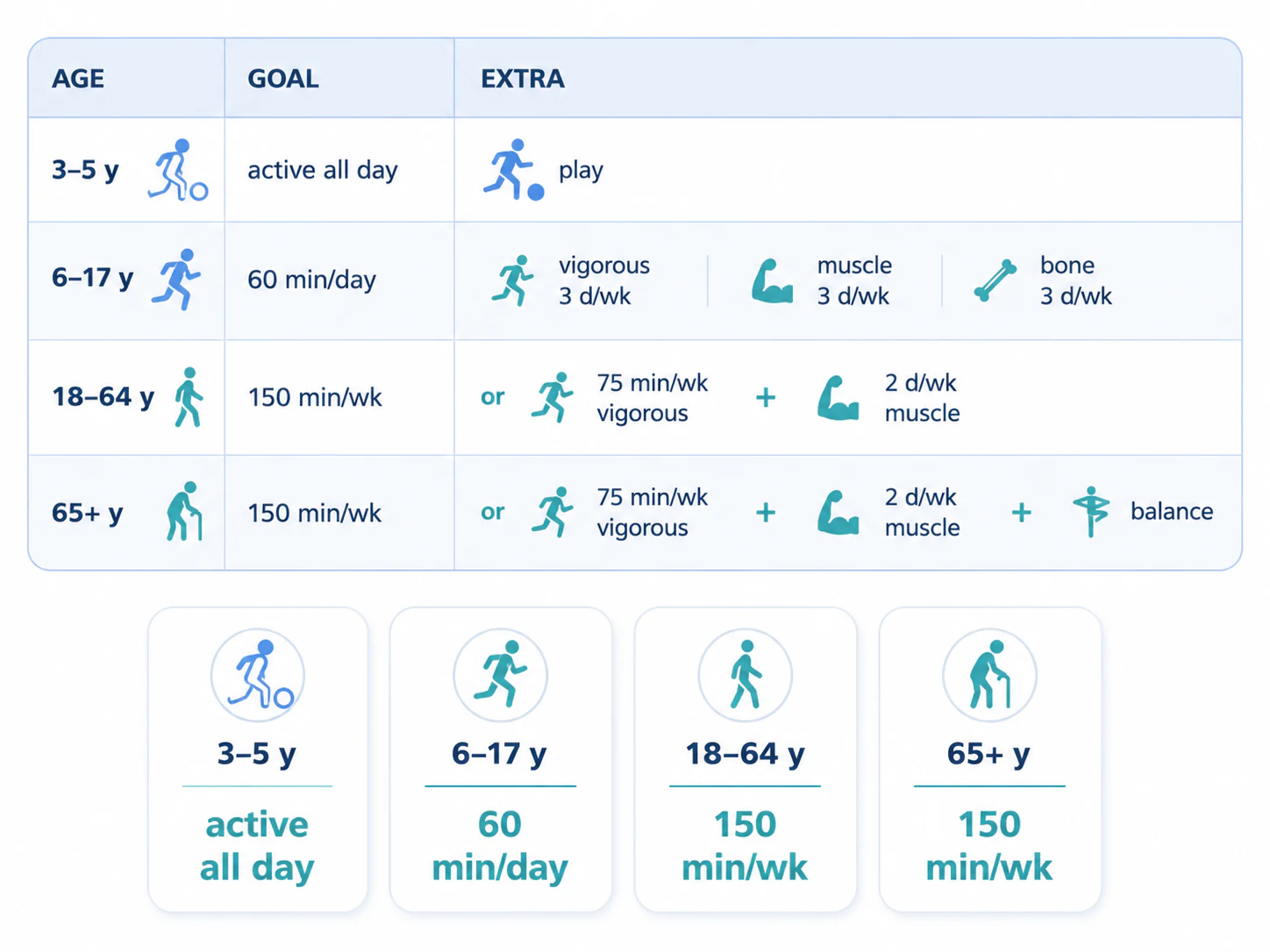
Physical activity recommendations by age:
| Age | Recommended activity | Focus |
|---|---|---|
| 3–5 years | Active throughout the day | Play, running, jumping, outdoor movement |
| 6–17 years | At least 60 minutes/day of moderate-to-vigorous activity | Aerobic, muscle-strengthening, bone-strengthening activity |
| 18–64 years | At least 150 minutes/week moderate activity, or 75 minutes/week vigorous activity | At least 2 days/week muscle strengthening |
| 65+ years | At least 150 minutes/week moderate activity, or 75 minutes/week vigorous activity | Muscle strengthening plus balance training |
Good habits for children and teenagers include:
- daily movement;
- running, jumping, ball sports, outdoor play;
- age-appropriate strength or bodyweight training;
- avoiding overtraining;
- eating enough when activity increases;
- not pushing through persistent pain or injury.
Examples include brisk walking, running, jumping rope, ball sports, swimming, cycling, climbing, dance, gymnastics, bodyweight training, and outdoor games.
Bone-strengthening activities often include running, jumping, ball sports, and climbing. Muscle-strengthening activities include climbing, push-ups, squats, bodyweight training, and resistance training when appropriate.
More exercise does not automatically mean more height.
If a child trains heavily but eats too little, sleeps too little, feels chronically tired, or gets injured repeatedly, the body may be under stress rather than supported.
Exercise builds stronger bones, muscles, and posture. It does not bypass genetics or growth plate closure.
4. Ignoring warning signs from the body
Some children are not simply “slow growers.” Their body may be showing other signs.
Persistent fatigue. Poor appetite. Unusual weight loss or gain. Repeated abdominal pain or diarrhea. Poor recovery after exercise. No signs of puberty by the expected age. Puberty starts but then does not progress.
These situations should not be handled only with more milk or more exercise.
If height growth slows down and other symptoms appear, professional evaluation is more appropriate. Sometimes the issue is not height itself, but a health problem affecting development.
Fast Height Claims Are Easy to Sell
The more urgent someone feels about growing taller, the more attractive fixed promises become.
Gain inches in a month. Height gummies for teens. Break through genetics. Open growth plates. Stimulate bone growth. A routine that makes you taller fast.
These claims feel powerful because they make a complex development process sound simple.
Credible information does not usually promise guaranteed height increase. It explains that height is influenced by genetics, puberty timing, nutrition, sleep, illness, hormones, and skeletal maturity. If growth plates are closed, ordinary methods cannot make long bones grow longer.
Low-trust marketing often does the opposite. It promises results, creates urgency, and turns selected testimonials into broad claims.
If a product or method claims guaranteed height increase, ask:
How does it work? Where is the evidence? Has it been clinically tested? Is it appropriate for the person’s age and development stage?
If the answers are vague, do not treat it as a height solution.
How to Track Height More Reliably
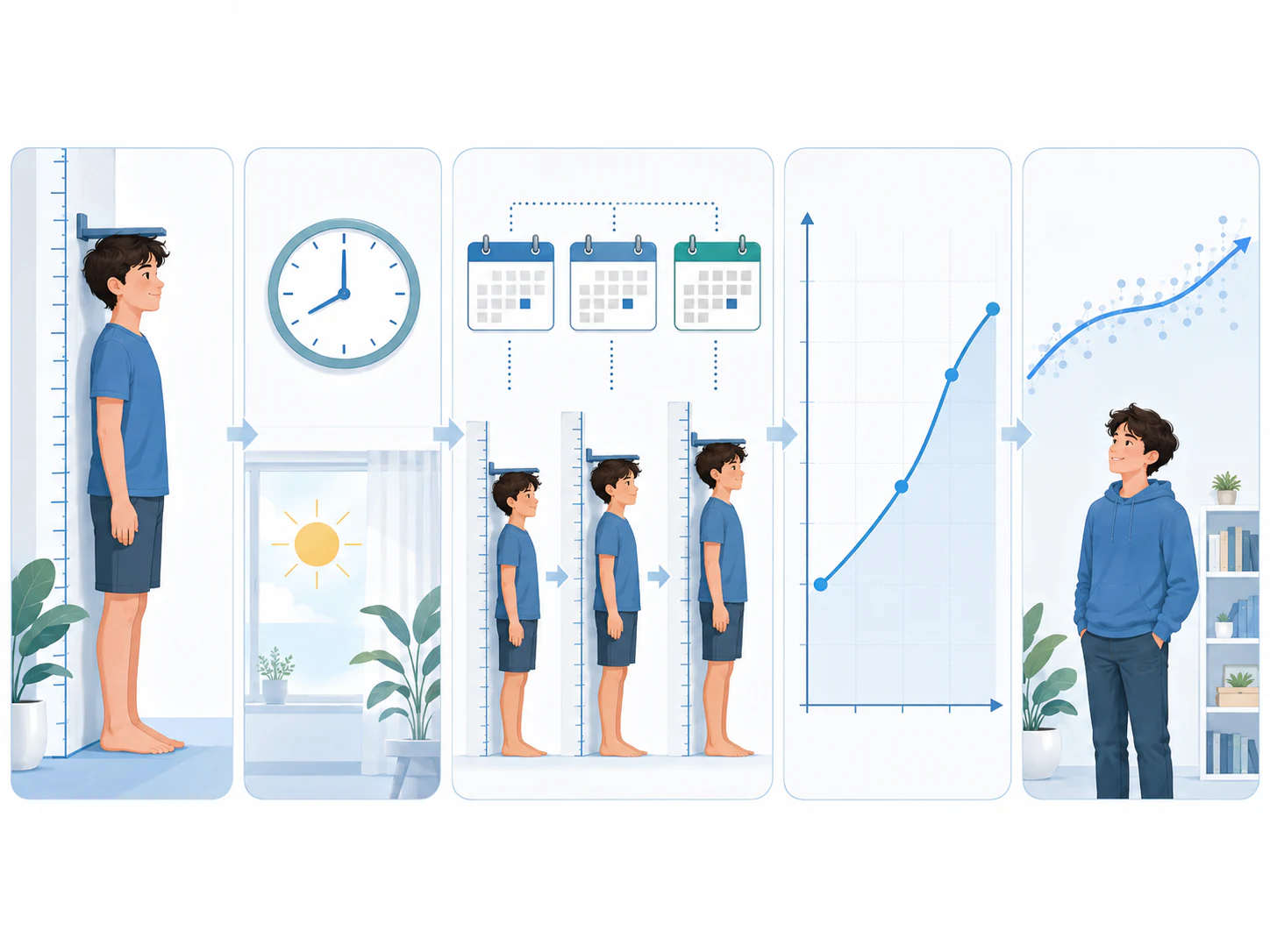
A single height number can create unnecessary anxiety.
One day the measurement is 165.2 cm, the next day 164.8 cm, then 165.4 cm. Small changes may come from measurement time, posture, spinal compression, hair, or tool angle. If notes mix centimeters and feet or inches, use a height converter before comparing records.
Track change over time instead.
Measure every two to three months.
Keep the conditions similar. Use the same time of day if possible. Measure barefoot. Stand against the wall with consistent posture. For a full setup checklist, see how to measure height at home.
Look for at least three records. One record is only a point. Two records show a direction. Three or more make a trend easier to judge. Once there are two reliable records, a height difference calculator can make the actual change easier to read.
Three Types of Height: Skeletal, Posture, and Visual
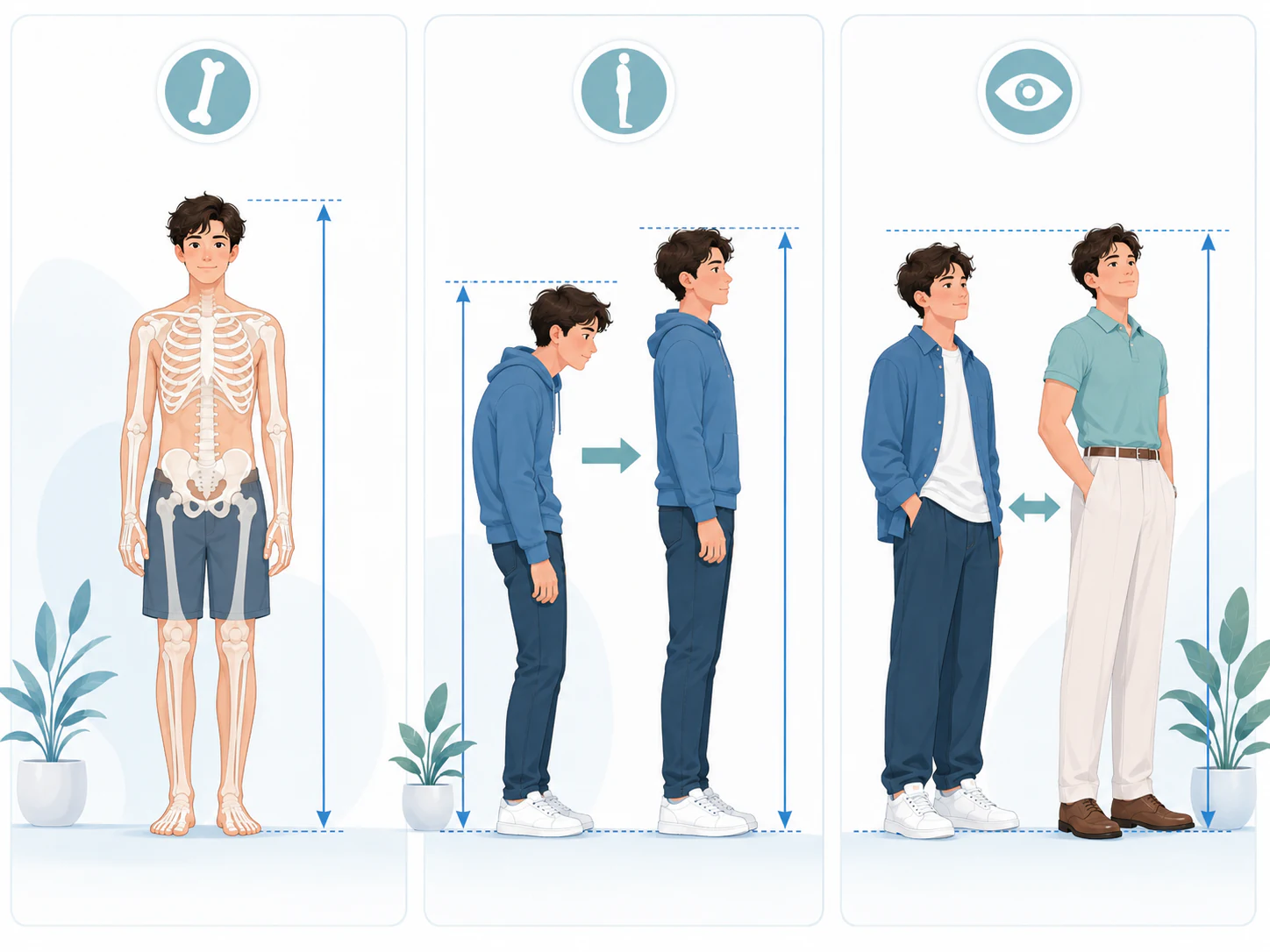
Many arguments about height happen because three different things are mixed together.
Skeletal height
This is height in the strictest sense. It is mainly determined by long-bone length, spinal structure, and skeletal development.
Children and teenagers may still increase skeletal height if they are still growing. Adults with closed growth plates usually cannot increase skeletal height through ordinary methods.
Posture height
The same person may look shorter with rounded shoulders, forward head posture, pelvic tilt, or long-term slouching. Strength training, mobility work, and posture changes may help the person stand more upright. For more visual cues, see why some people look taller than they really are.
This does not make bones longer. It can recover height that poor posture was hiding.
Visual height
Visual height depends on proportion and context.
The same real height can look different depending on posture, shoulder and neck position, body proportions, clothing, camera angle, mirror angle, and comparison with other people. A mirror visual simulator is useful here because it separates real height from reflection and viewing context.
After skeletal growth ends, the direction changes. Instead of trying to keep lengthening bones, focus on posture, strength, proportion, and visual presentation.
To know whether true height can still increase, look at skeletal growth. To stand taller, look at posture. To understand why someone looks taller or shorter in comparison, look at visual height.
Can You Grow Taller After 18? Look at Bone Age, Not Just the Birthday
Eighteen is not a universal biological closing date.
Some early developers have mostly finished height growth by 16 or 17. Some late developers may still gain a small amount after 18. Both can happen.
The key issue is skeletal maturity, not the birthday.
If growth plates are not fully closed, the long bones may still have some room to grow. Sleep, nutrition, activity, and overall health still matter.
If growth plates are closed, ordinary stretching, hanging, jumping, swimming, basketball, diet changes, or non-prescription supplements cannot make long bones longer.
Adults can still change some things.
Better posture, stronger back and core muscles, less slouching, better clothing proportions, and more natural camera angles can all make someone look taller and more upright.
But this is posture and visual presentation, not skeletal height increase.
After 18, the more precise question is not:
“Is there absolutely no chance?”
It is:
“Is my skeletal development complete?”
If someone is only curious, they do not need to demand testing. If height has not changed for a long time, puberty is clearly early or late, or the family is persistently concerned, a doctor can decide whether bone age assessment is needed.
How HowHeight Can Help You Understand Height
If you are still growing, HowHeight’s height percentile tool can help you see where your current height sits among people of the same age and sex. It cannot promise your final adult height, but it can give context.
If you have already stopped growing, height comparison, body proportion, and posture-related tools can help shift attention from “Can I gain a few more centimeters?” toward body understanding that is more practical.
Height is not an isolated number. It connects with age, puberty stage, weight, proportion, posture, and visual comparison.
Final Thought: Growth Is Not Something You Can Force
Many people want a faster answer.
One exercise. One food list. One schedule. One plan that makes height change.
Human growth does not work that neatly.
To know whether more height is possible, first ask whether the body is still in a growth period. If it is, protect sleep, nutrition, activity, and health. If it is not, do not place hope in fast-height promises.
Do not stare at the height mark every day as if pressure can make bones grow. During the growth period, avoid chronic sleep loss, eating too little, overtraining, and untreated health problems. If development looks abnormal, seek medical evaluation. After the growth period ends, focus on posture, strength, proportion, and self-understanding.
Height can affect how someone sees themselves.
But understanding height should not become another source of anxiety.
It should help people know what stage they are in, what is still worth doing, and which promises are not worth trusting.
Medical Disclaimer
This article is for general health education and body-growth information. It does not replace medical diagnosis, treatment advice, or individualized nutrition guidance. If a child or teenager has clearly abnormal height growth, very early or delayed puberty, persistent fatigue, unusual weight change, or other health concerns, consult a pediatrician or pediatric endocrinologist.