
Why Does My Height Look Different in Mirrors?
When one mirror makes you look taller and another shorter, the reason is usually the setup: mirror tilt, camera position, crop, distance, and room cues.
You may look normal in one mirror, shorter in another, and taller in a mirror selfie.
Your real height has not changed.
The mirror view changed.
Sometimes the mirror itself changes the image. A curved or uneven surface can shrink, enlarge, widen, or stretch part of the reflection.
Other times the mirror is flat, but the setup changes how tall the reflection appears. Tilt, camera height, distance, crop, floor lines, door frames, and lighting all affect the height you judge from the image.
The useful question is not whether your body changed. It is which part of the mirror setup changed the height you see.
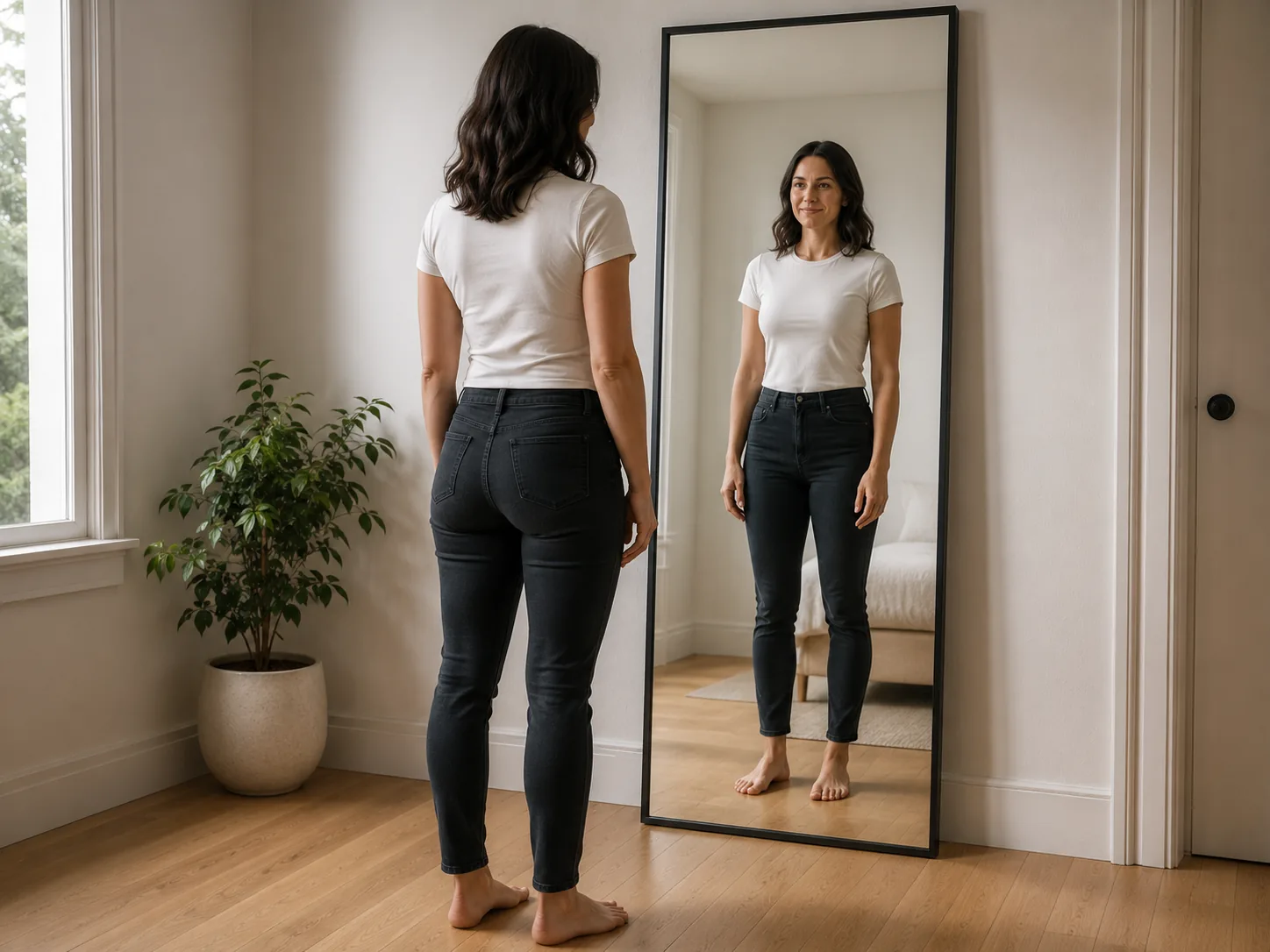
Real Height, Height in the Mirror, and Photo Height
Real height is the actual vertical distance from the bottom of your feet to the top of your head. Unless your shoes, posture, or measuring method changes, your real height does not change.
Height in the mirror is the height of the reflected image. It is not a second real body behind the mirror. It is a virtual image formed by reflected light.
Photo height is the amount of the camera frame your reflected body occupies. It depends on camera height, distance, focal length, crop, and framing.
Most mirror-height confusion starts when these are mixed together. A flat mirror can keep the virtual image the same size while a leaning frame, a high phone, cropped feet, or weak room references still make you look shorter or taller.
A Flat Mirror Usually Does Not Make You Taller or Shorter
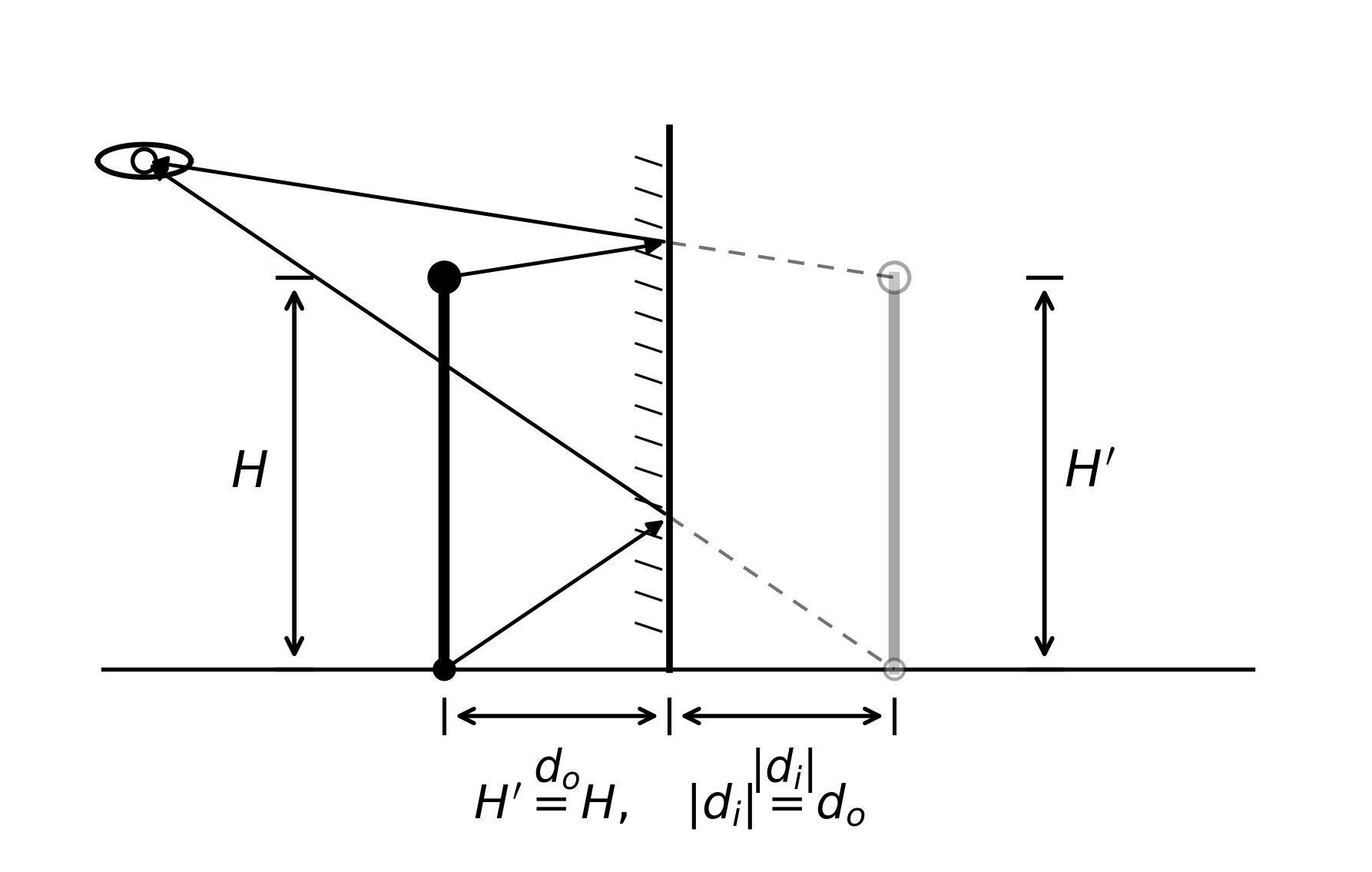
For an ideal plane mirror, the basic relationship is:
Formula: H′ = H; |dᵢ| = dₒ
In a flat mirror, the image is the same height as the real object, and it appears the same distance behind the mirror as the object is in front of it.
A perfectly flat mirror does not stretch your body, compress your legs, widen your waist, or make you physically taller in the mirror. It forms an upright, same-size virtual image.
When a flat mirror seems to change your height, the cause is usually outside the flat-mirror formula.
The mirror may be leaning; the phone may be held too high or too low; the feet may be cropped; the room may have weak reference lines; or the lighting may change how clearly the body outline reads.
If the surface is truly flat, the mirror image height stays stable. The perceived height changes because of angle, projection, crop, reference lines, or lighting.
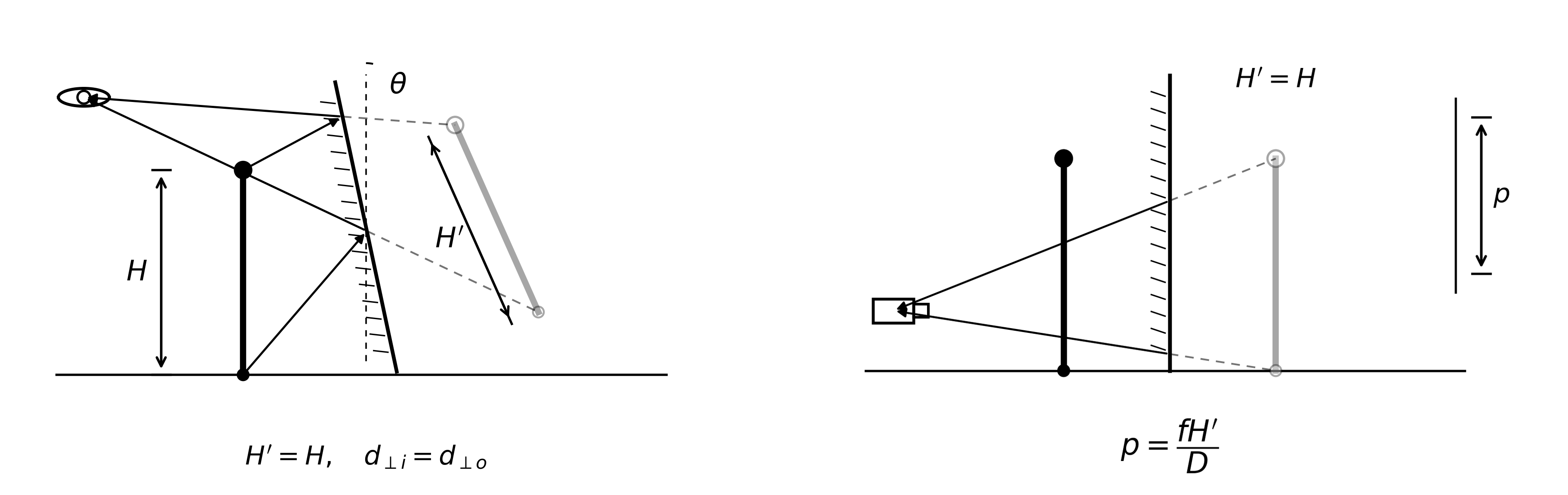
A Tilted Flat Mirror Changes Geometry, Not the Actual Image Height
A leaning full-length mirror is often blamed for making someone look taller.
If the surface is truly flat, tilt does not turn it into a magnifying mirror.
For a tilted plane mirror:
Formula: H′ = H
That formula means the reflected body is still same-size in the mirror's own geometry. Tilt changes where the virtual image appears, how it is oriented, and how it lines up with the floor, mirror frame, wall edges, and camera.
A leaning flat mirror can make you look taller by changing the scene around the same-size image. It changes apparent height, not flat-mirror magnification.
Mirror selfies add a second step. The phone does not measure your height. It records a projection of the mirror image.
In the diagram, H′ is the mirror image height, while p is the projected height in the camera image.
For the flat mirror:
Formula: H′ = H
But in the photo:
Formula: p changes
A lower phone position can make the legs take more of the frame. A high phone position often emphasizes the head and upper body, so the legs read shorter. Cropped feet remove the strongest height reference.
For a taller-looking mirror selfie, hold the phone around waist or hip height and tilt it slightly upward toward the mirror center or upper body. Keep the full body, feet, floor line, and mirror edges visible. A perfectly parallel phone is more neutral. A high phone position or downward tilt usually makes the body look shorter.
Keep the changes subtle. If the mirror leans too far or the phone tilts too aggressively, the floor line, door frame, and mirror edge will show the distortion.
Distance matters too. Stand far enough back to show the feet and room references. Very close wide-angle shots make perspective and edge distortion stronger. Zoom mostly changes framing unless you also move the camera.
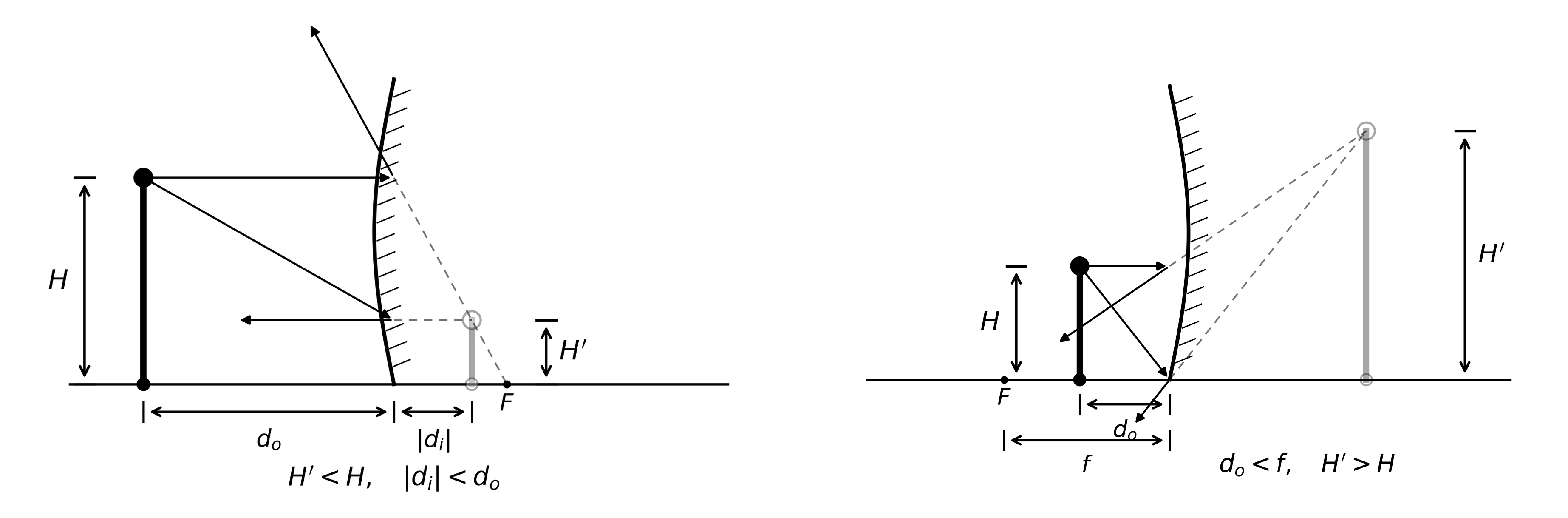
Curved Mirrors Can Change Mirror Image Size
Unlike a flat mirror, a curved mirror can change the size of the image.
A convex mirror spreads reflected light outward. It usually forms an upright, smaller virtual image:
Formula: H′ < H
People look smaller and farther away in convex mirrors. Examples include car side mirrors, store security mirrors, corridor mirrors, and some decorative round mirrors.
A concave mirror is different. It can magnify an image, but only under the right condition. When the object is inside the focal length of the concave mirror, the image can be upright, virtual, and larger:
Formula: dₒ < f; H′ > H
A close-up makeup mirror can enlarge your face for this reason. The same idea can apply to local mirror defects. If a section of a mirror is slightly concave, the part of the body aligned with that section may look enlarged.
In everyday mirrors, many distortions are small. A mirror does not need to look like a funhouse mirror to change proportions. A slight curve, uneven mounting surface, or local bend can be enough to make one area of the body look wider, shorter, larger, or less balanced.
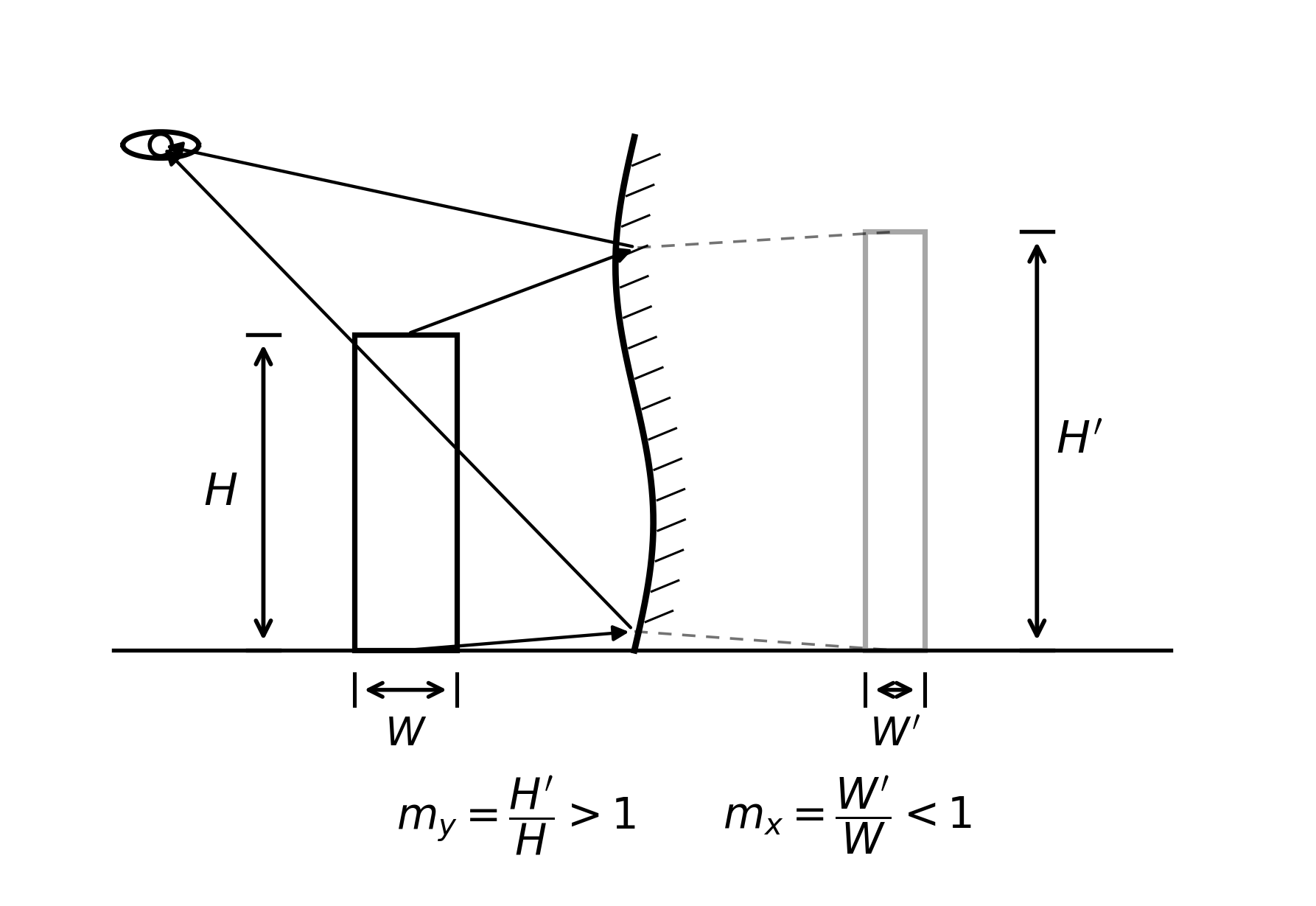
Some Mirrors Change Width and Height Differently
Some mirror distortion is not uniform. It does not enlarge the whole body evenly.
A useful way to express this is:
Formula: mᵧ = H′ / H; mₓ = W′ / W
Here, mᵧ describes vertical magnification and mₓ describes horizontal magnification.
A mirror can make the body look taller if vertical size is preserved or slightly increased while horizontal width is reduced:
Formula: mᵧ ≈ 1 or mᵧ > 1; mₓ < 1
That is why a narrowing distortion can feel like a height change. The body did not become taller; the height-to-width ratio changed.
The signs are usually subtle: shoulders look narrower, waist and hips look compressed, legs read longer, and the body looks longer and slimmer.
If the mirror frame, door frame, floor tiles, and wall lines bend noticeably, the distortion is no longer hidden. The room gives it away.
Why Some Mirrors Make You Look Shorter
A mirror that makes you look shorter is not always shrinking the mirror image.
It may be a convex or uneven surface that reduces image size. It may be a high phone angle that gives more visual weight to the head and upper body. It may be cropped feet, which remove the floor contact that helps the body read as full height.
Width can also change height judgment. If the shoulders, waist, hips, or thighs look wider, the same vertical length can feel shorter because the height-to-width ratio changes.
Background lines matter too. A slanted floor line, tilted mirror frame, warped door frame, or curved wall edge can make the body harder to judge.
So the shorter look usually comes from one of four places: curved surface, camera projection, cropped height reference, or unstable room references.
Room Lines and Lighting Can Change Height Judgment
Even when the mirror is not strongly distorted, the room can change how height reads.
Straight references are the most important. Door frames, mirror edges, tile lines, baseboards, and the floor under your feet help you tell whether the scene is straight.
If those references lean, curve, or disappear from the frame, the body becomes harder to judge. A cropped foot line can make a full-height reflection feel shorter. A warped door frame near the hips or legs is a warning that the body may be warped in the same area.
Lighting is secondary, but it still matters. It does not change real height or the same-size image from a flat mirror. It changes the body outline. Hard side light can make the body edge sharper; flat front light can make the outline wider and less defined.
Keep the point narrow: background lines and body edges affect perceived height. They do not replace the main mirror geometry.
How to Check Whether a Mirror Is Changing Your Height
Do not only look at your body. Look at the reference lines around your body.
Check the Mirror Frame: A straight frame should remain straight. If the frame bends, the mirror or image geometry may be distorted.
Check Door Frames and Wall Corners: Door frames and wall corners should look straight. If they lean or curve, the mirror or camera angle may be affecting how your height reads.
Check the Floor Line: Floor tiles, baseboards, and the wall-floor edge should look natural. A slanted or curved floor line can change how tall the body feels.
Check the Feet: Feet and floor contact are critical for full-body height. If the feet are cropped, height is harder to judge.
Change Distance: Step closer, then farther away. If the body changes a lot, distance and viewing angle are affecting the result.
Change Phone Height: Take one mirror photo from a high position, one from chest level, and one from a lower position. If the difference is large, the change is coming from camera projection, not real height.
How to Get a More Reliable Mirror Height View
For a mirror view closer to real proportions, make the setup stable.
Keep the mirror close to vertical. Stand far enough back to show your feet, the floor line, and at least one straight room reference. Avoid close wide-angle mirror selfies when judging height.
Use lighting that keeps the body edge visible without washing out the waist, legs, and floor contact.
Then check the room before judging your body. If the mirror frame, door frame, wall edge, and floor line all look natural, the height you see is easier to trust.
If you want a mirror selfie to look a little taller, keep it simple: phone near waist or hip height, slight upward tilt, full feet visible, and straight background lines still looking straight.
Conclusion: Different Height in the Mirror Does Not Mean Your Real Height Changed
Height looks different in different mirrors because height in the mirror is not a direct measurement of real height.
It is a reflected image shaped by mirror surface, mirror angle, curvature, viewing position, phone projection, distance, lighting, body outline, and background reference lines.
A practical summary:
A flat mirror usually keeps mirror image height equal to real height. A tilted flat mirror changes geometry and references, not the actual image size. A camera changes photo projection. A convex mirror can make the image smaller. A concave mirror can magnify under the right condition. A non-uniform mirror can change height and width differently. Lighting changes body edges, not real height.
When one mirror makes you look taller and another makes you look shorter, check the setup first: the mirror, the background, your feet in the frame, the camera position, and the lighting.
If you want to compare these changes visually, you can use HowHeight’s Mirror Visual Simulator to test height, width, angle, and curved mirror effects on the same body photo.
Your real height stays the same. The mirror view changes because the reflection, room, camera, and lighting change what you see.
FAQ
Can a mirror really make me look taller?: Yes, but the mechanism matters. A flat mirror usually does not truly increase mirror image height. However, mirror tilt, camera projection, cropping, curvature, and width compression can make you look taller.
Does a flat mirror change height?: An ideal flat mirror forms an upright, same-size virtual image. In that case, the mirror image height equals the real object height.
Why do I look shorter in some mirrors?: You may be seeing convex mirror shrinkage, a high phone angle, cropped feet, wider body proportions, unstable background lines, or lighting that weakens the lower-body outline.
Why do slimming mirrors also make people look taller?: Because narrowing the body changes the height-to-width ratio. If horizontal width is compressed while vertical height is preserved or slightly stretched, the body can read taller and slimmer.
Why do mirror selfies change my height so much?: The phone records a projection of the mirror image. Phone height, tilt, distance, lens choice, crop, and whether the feet are visible can change how much height the body occupies in the photo.
How can I tell if a mirror is distorted?: Check straight references: mirror frame, door frame, wall corners, floor tiles, and baseboards. If those lines bend or lean, the reflection may be distorted.
How can I make mirror photos look more natural?: Keep the mirror close to vertical, stand farther back, avoid close wide-angle shots, keep the feet visible, and make sure background lines remain straight.